
FKIP UNTAN English Education Lecturers Conduct Community Service Programme to Strengthen Digital and AI Literacy among English Teachers in Sambas
Sambas Regency, West Kalimantan — Lecturers from the Undergraduate English Language Education Study Programme, Faculty of Teacher Training and Education, Universitas Tanjungpura (FKIP UNTAN) conducted a Community Service Programme (Pengabdian kepada Masyarakat/PKM) at SMP Negeri 3 Teluk Keramat, Sambas Regency. The programme brought together English teachers from across Sambas Regency and neighbouring Bengkayang Regency in a 32-hour series of activities focusing on digital literacy, digital learning materials, artificial intelligence, and interactive and gamified English learning.
A total of 33 teachers participated in the programme. Thirty were members of the English Teachers’ Association (MGMP) of Sambas Regency, representing both junior and senior secondary schools, while three additional participants came from GEBRAK (Gembira Bergerak) of Bengkayang Regency.
Opening the Community Service Programme
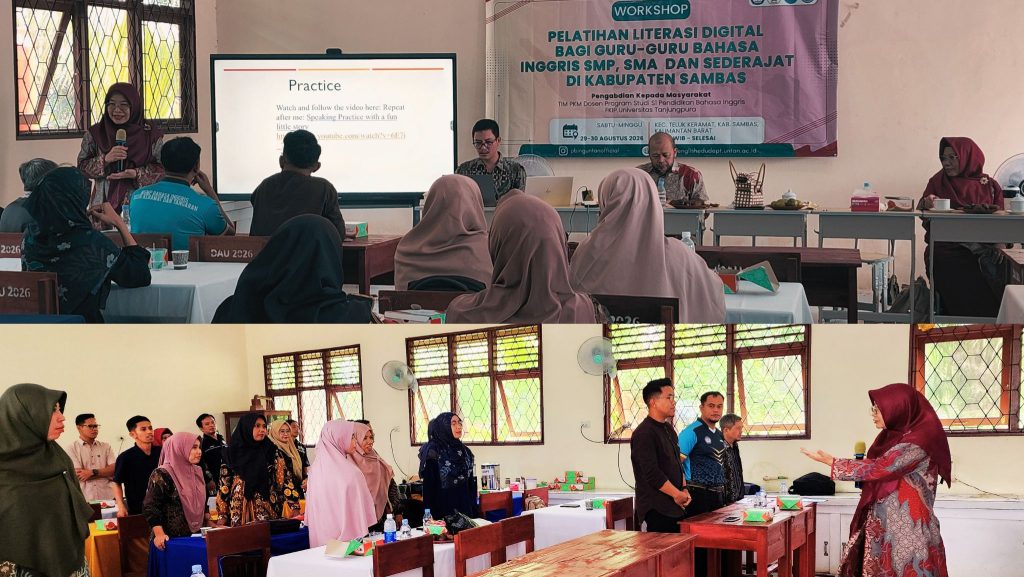
The programme was formally opened by Sumarni, M.TESOL, a member of the PKM team from the Undergraduate English Language Education Study Programme, FKIP UNTAN.
The opening was followed by remarks from Yanti Sri Rezeki, who introduced the academic vision and objectives of the English Language Education Study Programme. In her remarks, she also highlighted the programme’s efforts to communicate its academic activities, achievements, educational initiatives, and engagement with the wider community through its official website and Instagram platform.
The opening session provided participants with a broader picture of the study programme’s commitment not only to teaching and research at the university, but also to strengthening its engagement with schools, teachers, and educational communities through community service.
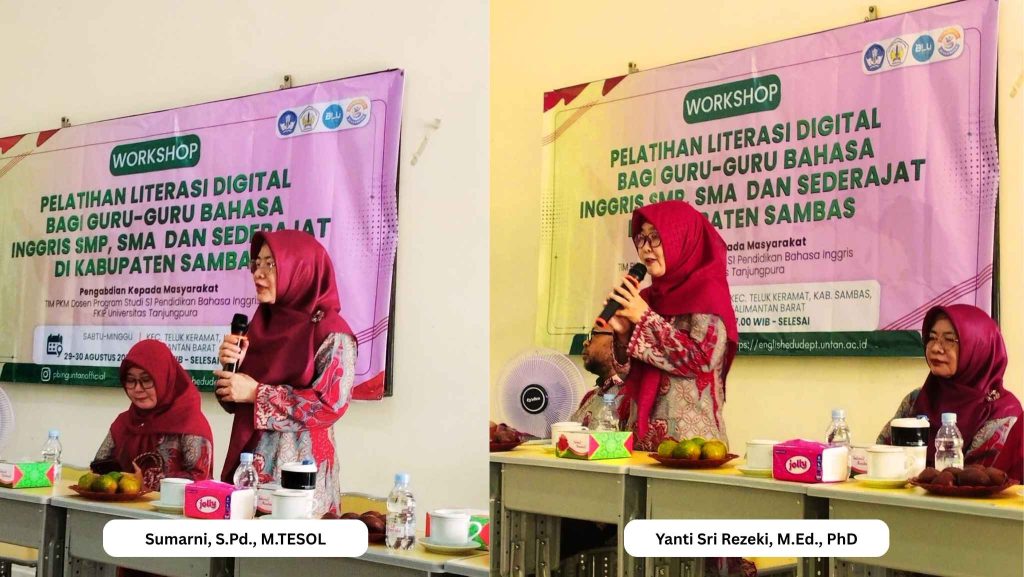
Sumarni formally opens the Community Service Programme at SMP Negeri 3 Teluk Keramat, followed by remarks from Yanti Sri Rezeki introducing the academic vision and community outreach of the Undergraduate English Language Education Study Programme, FKIP UNTAN.
Bringing Together English Teachers from Sambas and Bengkayang
The majority of participants were English teachers affiliated with the MGMP of Sambas Regency, covering both junior and senior secondary school levels. Their participation created an opportunity for teachers working in different school contexts to exchange experiences while exploring current developments in educational technology.
The programme was also joined by representatives of GEBRAK (Gembira Bergerak) from Bengkayang Regency. The delegation was led by Agusno Sumantri, S.Pd., Coordinator of the GEBRAK Team of Bengkayang Regency and Headteacher of SMP Negeri 3 Sanggau Ledo, together with two experienced teacher members.
Their presence added an inter-regency dimension to the programme and strengthened professional connections among English teachers from Sambas, Bengkayang, and the PKM team from Universitas Tanjungpura.
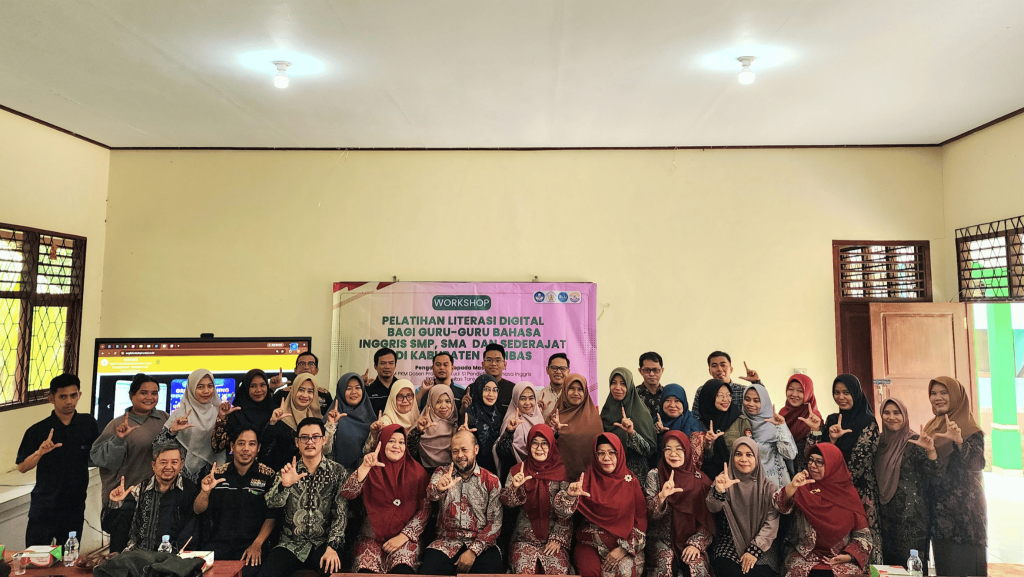
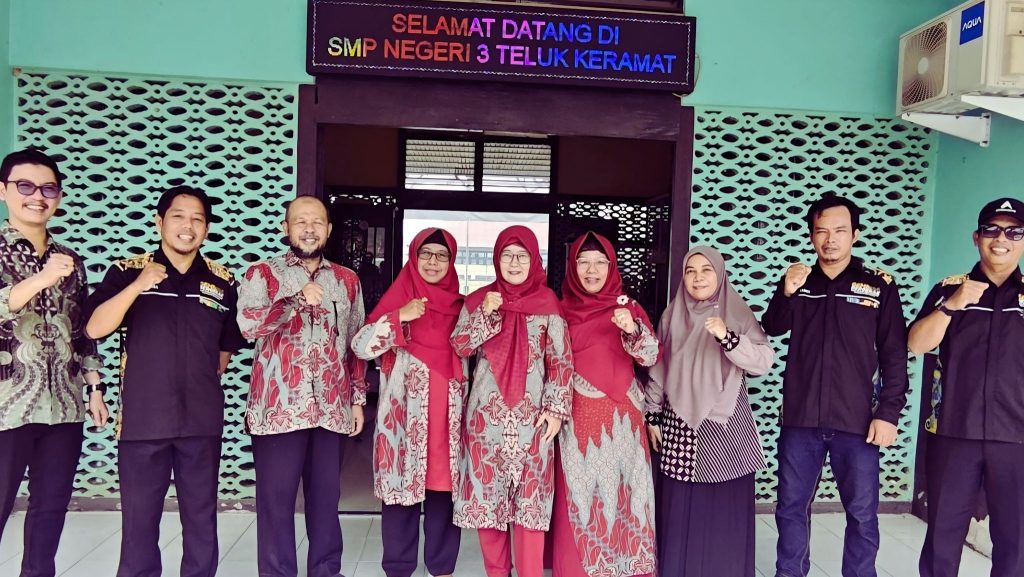 Members of the PKM team together with representatives of GEBRAK Bengkayang, SMP Negeri 3 Teluk Keramat, and participating teachers.
Strengthening Digital Literacy for English Teachers
One of the main sessions, “Digital Literacy for 21st-Century English Teachers,” was delivered by Endang Susilawati.
The session encouraged teachers to view digital literacy as more than the ability to operate applications and devices. Participants were invited to consider how teachers can critically select and use digital resources according to their students, instructional objectives, and classroom contexts.
Digital literacy was therefore positioned as part of teachers’ professional competence in responding to increasingly technology-rich educational environments.
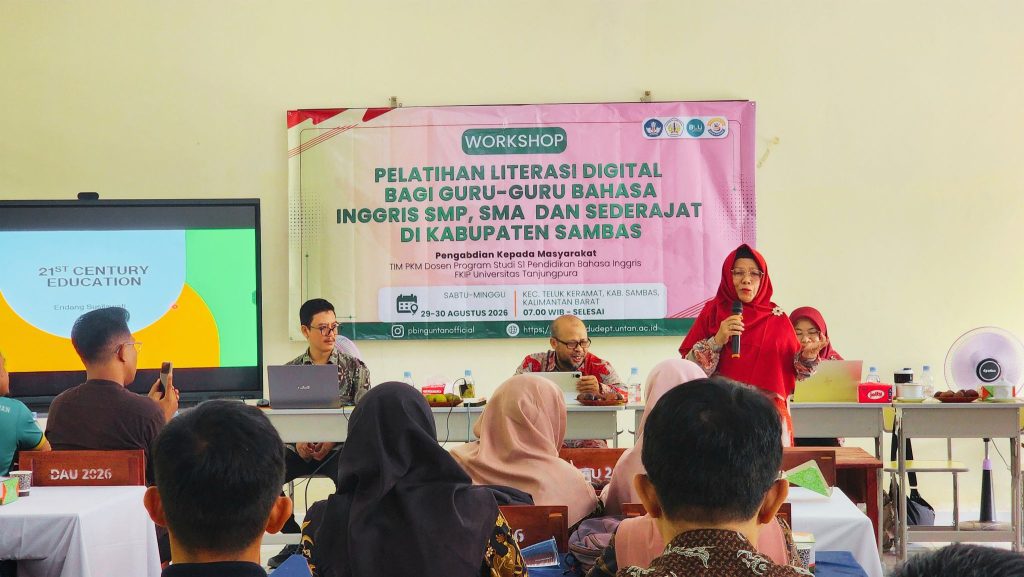 Endang Susilawati delivers a session on digital literacy for 21st-century English teachers.
Designing Engaging Digital Learning Materials
The next session, “Creating Engaging Digital Learning Materials,” was facilitated by Sumarni, M.TESOL.
The session focused on how digital learning materials can be designed to support meaningful learning rather than merely provide visually attractive content. Participants were encouraged to consider learning objectives, students’ needs, the organisation of information, and the appropriate use of multimedia when preparing digital learning resources.
The discussion reinforced the importance of placing pedagogy before technology: digital tools should be selected because they support learning, rather than simply because they are new or visually appealing.
 Sumarni, M.TESOL discusses principles and practices for developing engaging digital learning materials.
Building AI Literacy among English Teachers
Artificial intelligence was addressed through the session “AI Literacy for English Teachers,” delivered by Urai Salam, Ph.D.
The session introduced participants to the growing role of generative artificial intelligence in education and explored how AI may assist teachers in carrying out a range of professional and instructional tasks.
At the same time, the session emphasised the continuing role of teachers as decision-makers. Participants were encouraged to critically evaluate AI-generated information and materials, taking into account their accuracy, appropriateness, relevance to students, and pedagogical value.
Rather than positioning AI as a replacement for teachers, the programme presented it as a tool whose educational value depends on informed and responsible human judgement.
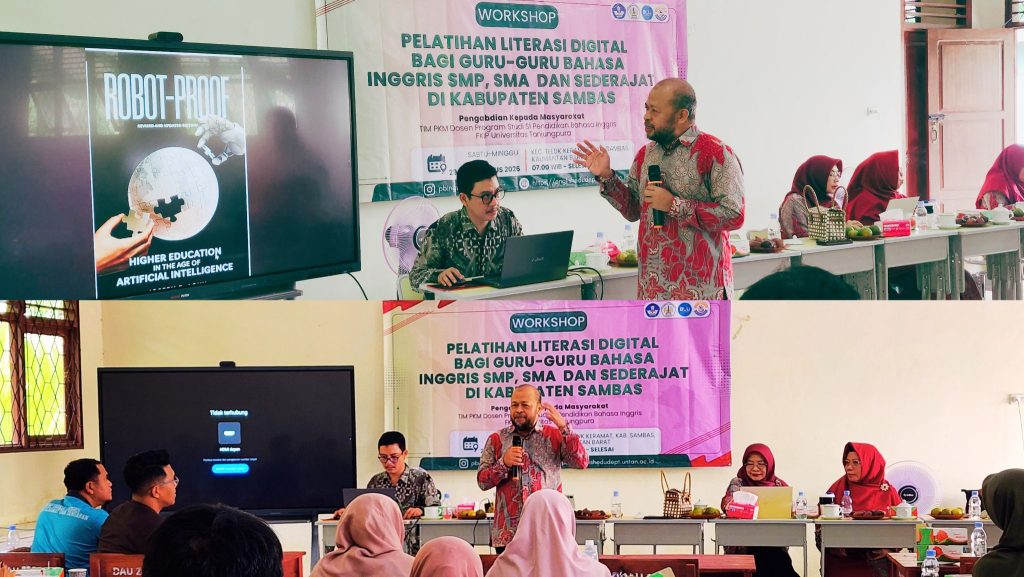 Urai Salam, Ph.D. discusses AI literacy and the responsible use of generative artificial intelligence in English language teaching.
Exploring Interactive and Gamified English Learning
The final workshop session centred on “Interactive and Gamified English Learning,” delivered by Chandra Fauzi, S.Pd., Gr., M.Pd. The session began with participants answering a short set of questions related to interactive and gamified English learning. This initial activity encouraged them to reflect on their existing understanding and provided a starting point for the concepts and practical examples explored throughout the session.
Participants were then introduced to ways of making English learning more interactive through game-inspired activities, digital tools, and learning experiences designed to encourage active participation.
Rather than discussing gamification only at a conceptual level, participants were also given the opportunity to experience a gamified learning activity directly by trying out the Sambas Adventure Game. The activity allowed the teachers to take the role of learners and experience how challenges, interactive tasks, game progression, and contextual elements could be incorporated into an English learning environment.
The hands-on activity provided a practical bridge between the ideas presented during the session and their possible classroom applications. By interacting with the game themselves, participants could observe how a digital game might create a more engaging learning experience while maintaining a clear connection with language-learning tasks.
The session emphasised that gamification does not simply mean adding games, points, or rewards to a lesson. Instead, interactive and gamified elements should be intentionally designed around learning objectives, meaningful learner participation, appropriate levels of challenge, and useful feedback.
This interactive game also demonstrated how a learning activity could incorporate a local context into a digital environment, providing participants with an example of how technology and gamification may be adapted to the learners and communities in which English is taught.
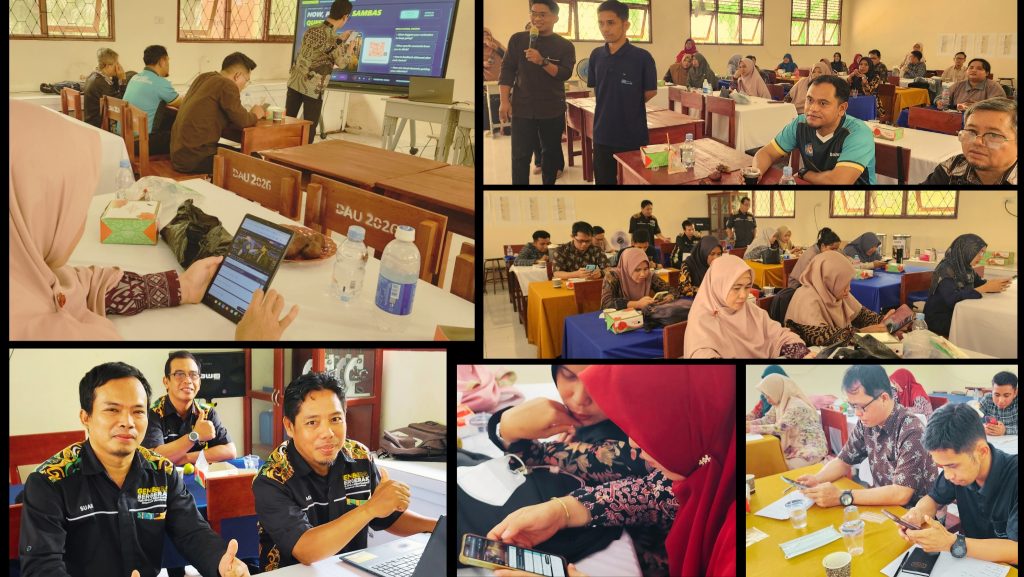
Participating English teachers engage with the introductory activity and experience the Sambas Adventure Game during the interactive and gamified English learning session at SMP Negeri 3 Teluk Keramat.
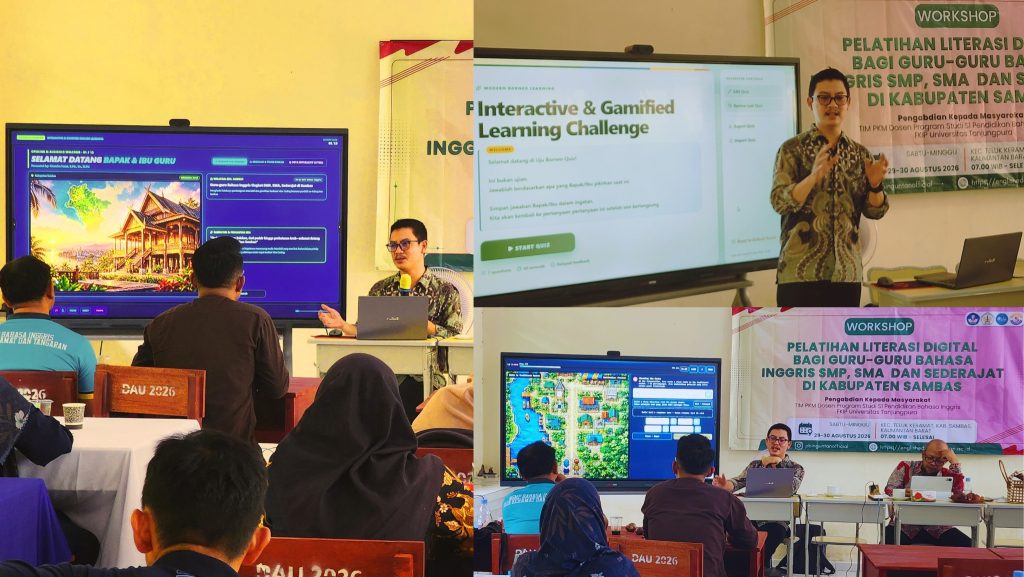 Chandra Fauzi demonstrates approaches to interactive and gamified English learning during the PKM programme.
A Collaborative PKM Team from FKIP UNTAN
The Community Service Programme was conducted by a team from the Undergraduate English Language Education Study Programme, FKIP Universitas Tanjungpura, consisting of Yanti Sri Rezeki, Endang Susilawati, Urai Salam, Sumarni, Wardah, Eka Fajar Rahmani, and Chandra Fauzi.
The team was also supported by Pak Agung, a senior staff member of FKIP UNTAN, who assisted with transportation and logistical support for the journey from Pontianak to the programme venue in Teluk Keramat.
Through the programme, the lecturers brought their academic expertise directly into a school and teacher-community setting. The activity reflected the role of community service as one of the three pillars of higher education in Indonesia, alongside teaching and research.
Continuing Collaboration beyond the University
The programme concluded with appreciation to the participating teachers, the MGMP of Sambas Regency, representatives of GEBRAK Bengkayang, SMP Negeri 3 Teluk Keramat, and all parties who supported the implementation of the activity.
More broadly, the programme reflected the commitment of the Undergraduate English Language Education Study Programme, FKIP UNTAN, to extending its academic contribution beyond the university and building stronger connections with English teachers and schools in West Kalimantan.
As digital platforms and artificial intelligence continue to develop, the programme highlighted an important principle for English language education: technology should serve teachers and learners, while sound pedagogical judgement remains at the centre of the learning process.
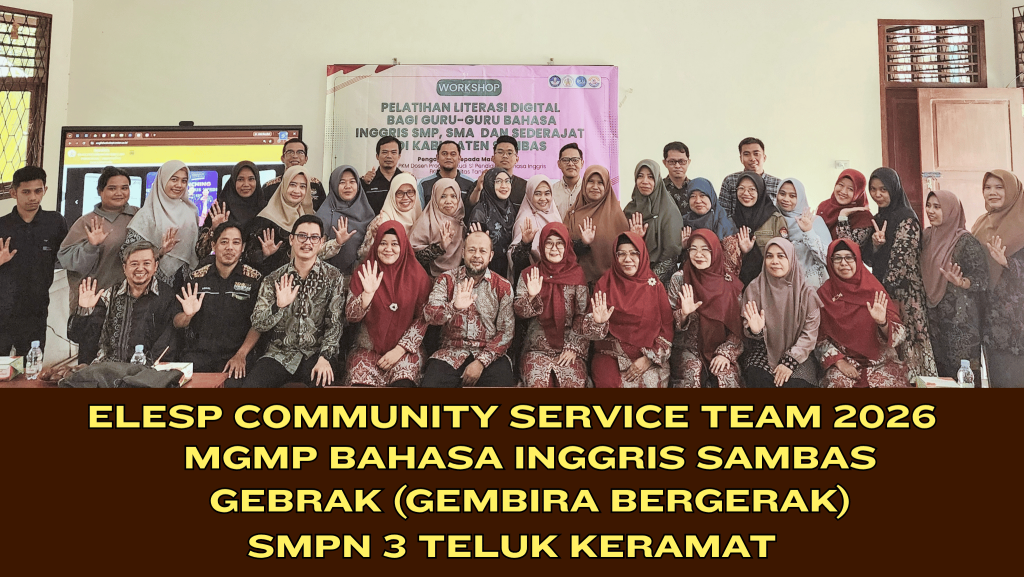 The closing of the Community Service Programme at SMP Negeri 3 Teluk Keramat, marking the completion of the 32-hour programme and continued collaboration between FKIP UNTAN, English teachers, schools, and teacher communities in West Kalimantan.